01
01
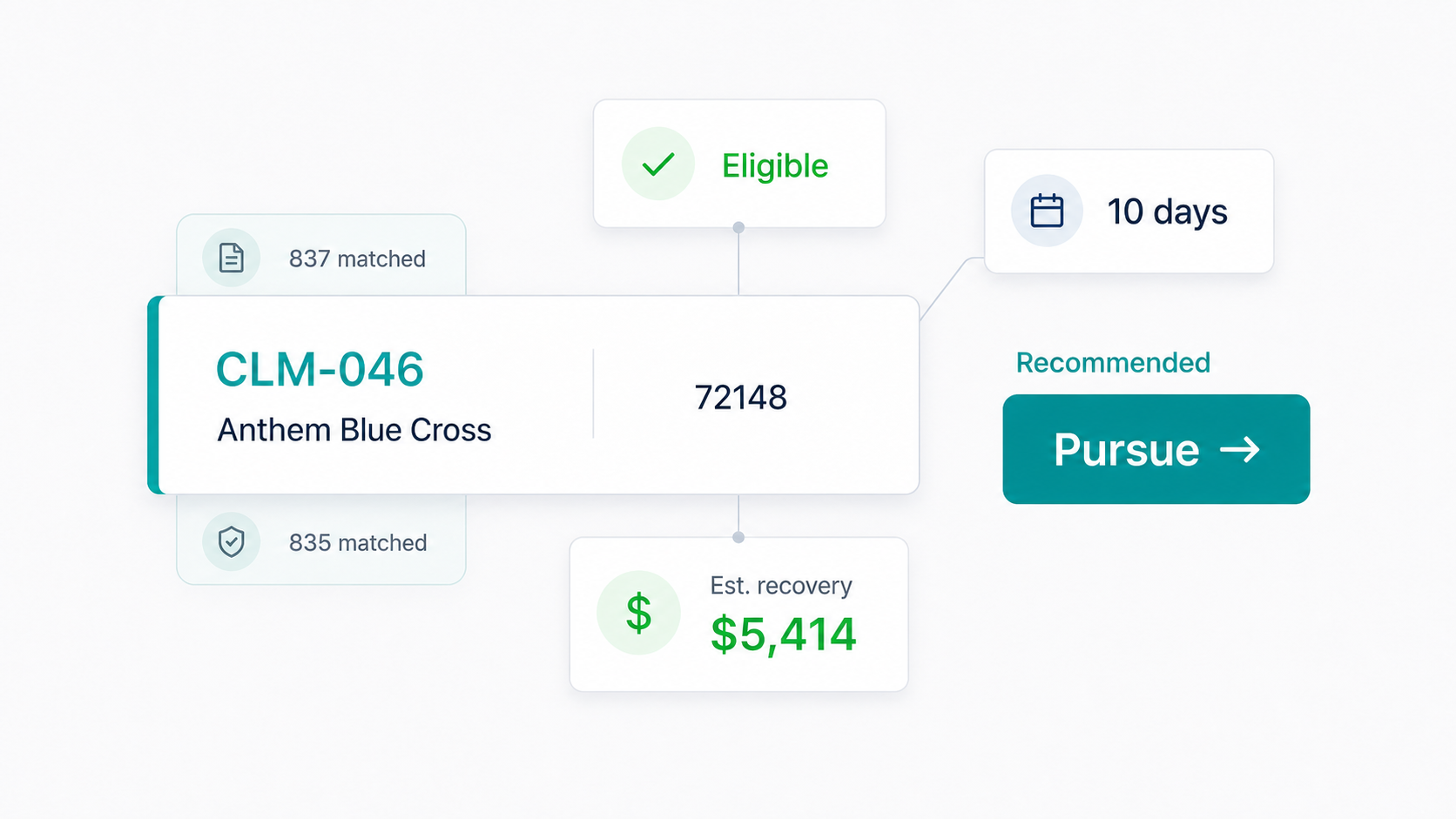
Claim selection
Find the claims worth pursuing.
Recourse reads your claims and remittance data, confirms eligibility, maps every deadline, and prioritizes the disputes with the strongest recovery potential.
IDR that learns
Recourse runs every step of IDR, then puts what it learned to work on the next claim.
The full feedback loop
Because Recourse runs the full process, it sees the claim, the decisions made, and the result. That result improves the next round.
More claims completed
Keep every eligible dispute moving from intake through filing.
More recovered per claim
Use claims intelligence to strengthen the ask and the evidence behind it.
01
Claim selection
Recourse reads your claims and remittance data, confirms eligibility, maps every deadline, and prioritizes the disputes with the strongest recovery potential.
02
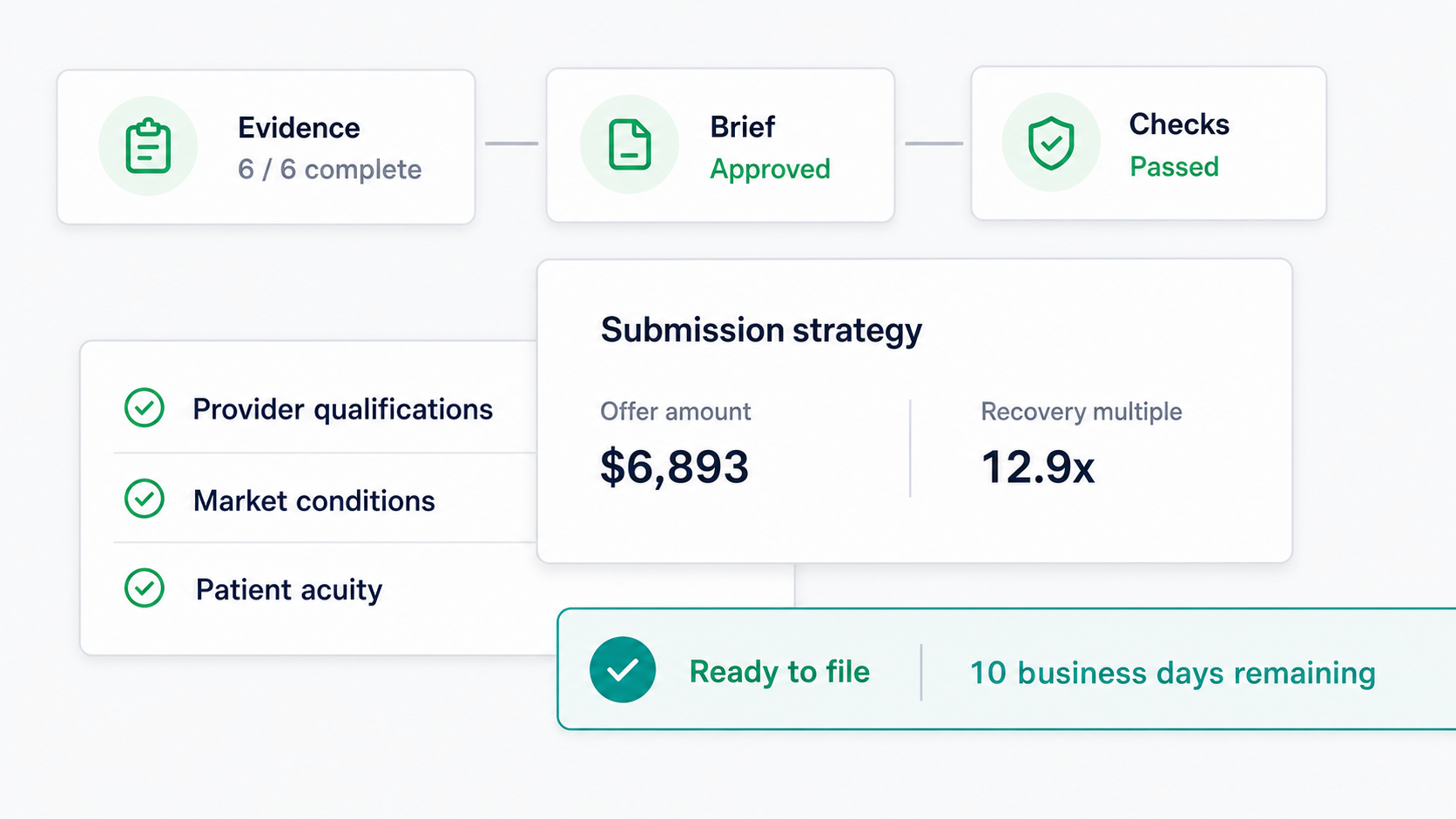
Submission intelligence
Claims intelligence guides the offer and supporting argument. Recourse assembles the evidence, addresses every statutory factor, and files the complete submission on time.
03
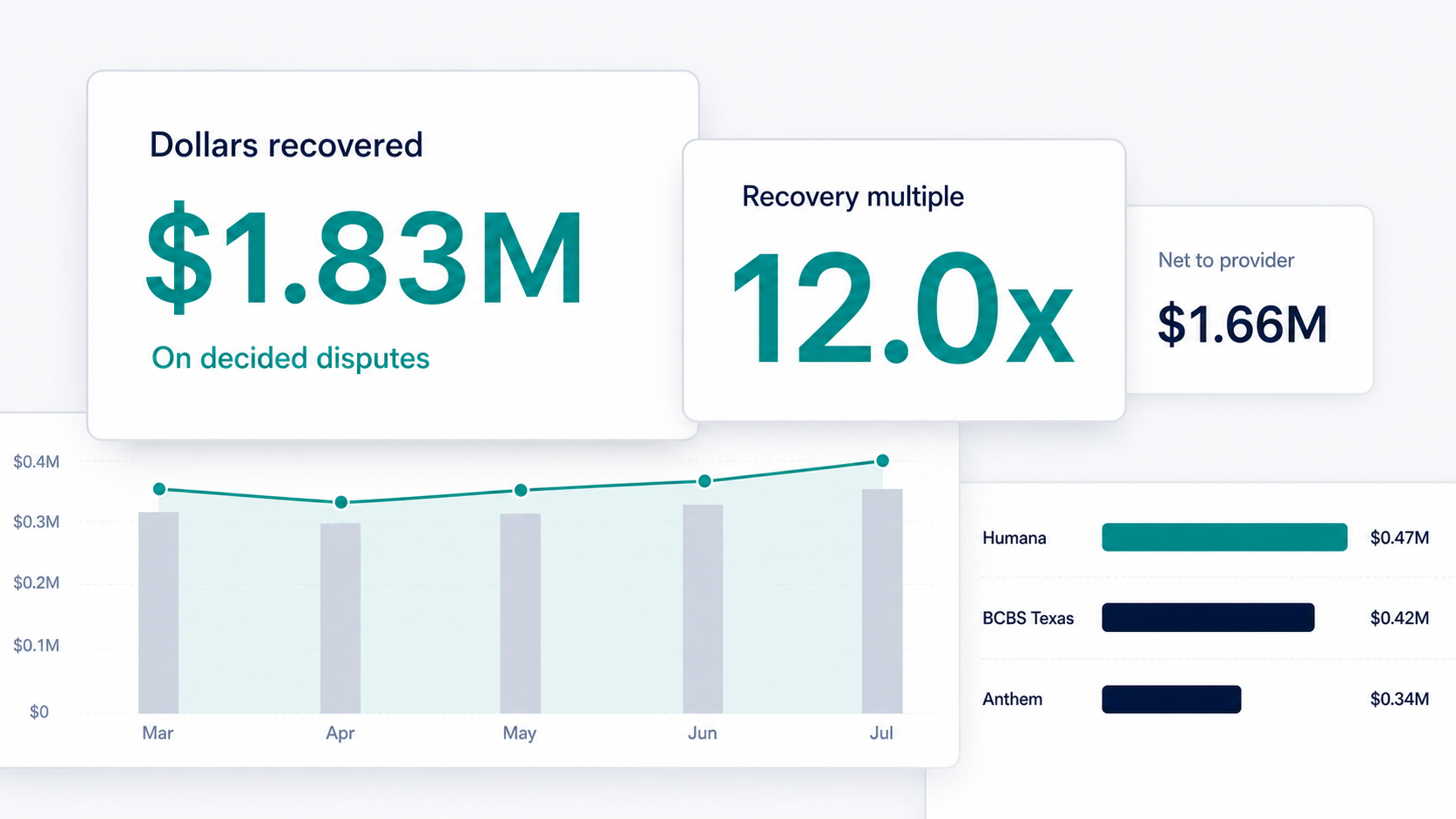
Outcome capture
Recourse records the payer response, determination, award, and recovery, including which arguments the IDRE credited and where the payer conceded.
Applied to the next claim
The result changes the next decision.
What the IDRE credited, where the payer conceded, and what was recovered improve which claims Recourse pursues, what it asks for, and which evidence it puts forward next.
What learning actually means
Recourse connects every result to the claim, payer, ask, and evidence behind it. Then it puts that lesson to work on the next similar claim.
A claim is decided
Payer behavior
Where the plan conceded
IDRE reasoning
Which evidence was credited
Recovery
What was awarded and collected
The next similar claim
Pursue
Rank the next similar claim
Ask
Set the offer with real outcome context
Build
Lead with the evidence that moved the result
That is the closed loop
Every decided claim gives the next one a better starting point.
Meet Remedy: one agent, every stage
Remedy works every stage of the dispute. It reads, checks, drafts negotiations, files and collects, shows you each step as it happens, and brings your team in for the exceptions and the calls that matter.
01
Shows its work
Every step and every reason go on the record as they happen.
02
Earns trust first
It watches 50 clean confirmations before it acts alone.
03
Knows when to stop
Field conflicts, payment items and money lines always go to a person.
What the agentic loop changes
Remedy does the work; the learning loop makes it better each time. Together they improve recovery in two ways: more eligible claims become worth pursuing, and every completed filing carries more recovery potential.
More claims pursued
Remedy lowers the filing threshold, so smaller claims are worth pursuing.
More recovered per claim
Each result feeds the loop and improves the next ask and evidence.
First lever: claim coverage
Remedy watches your payment data for IDR opportunities and carries the work from eligibility through submission. That makes smaller claims economical to pursue and opens more of your eligible claim pool.
More claims identified. More disputes completed. More dollars recovered.
What Remedy changes
Lower threshold
Remedy makes smaller claims economical to pursue.
Larger claim pool
More eligible claims can move through recovery.
No new work queue for your billing team. Your team handles the exceptions and the calls that matter while Remedy runs the process.
Second lever: recovery per claim
Across 5.7 million decided claim lines, a filer's win rate does not tell you how much it recovered. What it asked for does. Finishing more disputes creates the opportunity. A stronger filing strategy increases the value of each one.
Filers sorted by how much they ask for, into four groups of equal claim volume. Dollars awarded for every $1 in the health plan's offer.
And the win rate while that happens
Increasing ask →
Bottom quarter by ask
88.1%
Win rate
2.08x
Recovered per $1 offered by the plan
Third quarter by ask
88.9%
Win rate
4.08x
Recovered per $1 offered by the plan
Twice the recovery. The same win rate.
Recourse strengthens the offer and the evidence behind it, so each completed filing has more recovery potential.
Already filing yourself? See this analysis on your own book with Recourse Analytics →
CMS Federal IDR Public Use Files, 2025, out of network emergency and non-emergency. 5,722,651 decided claim lines after removing repeated line items. Filers are provider email domains with 500 or more priced lines, 126 of them. Recovery multiples are computed on the 3,437,726 lines where CMS reports a qualifying payment amount, and are capped at the 99th percentile. Multiples are ratios of offers, not dollar amounts. The relationship between ask and win rate varies by specialty.
Aligned incentives
Our compensation comes only from the recovery we create for your organization.
Contingency, in plain English
We only earn a fee from dollars we recover for you.
The success fee is agreed based on the scope and claim profile. It is earned only on dollars Recourse recovers.
See my CMS benchmark →Easy to adopt. Built for healthcare.
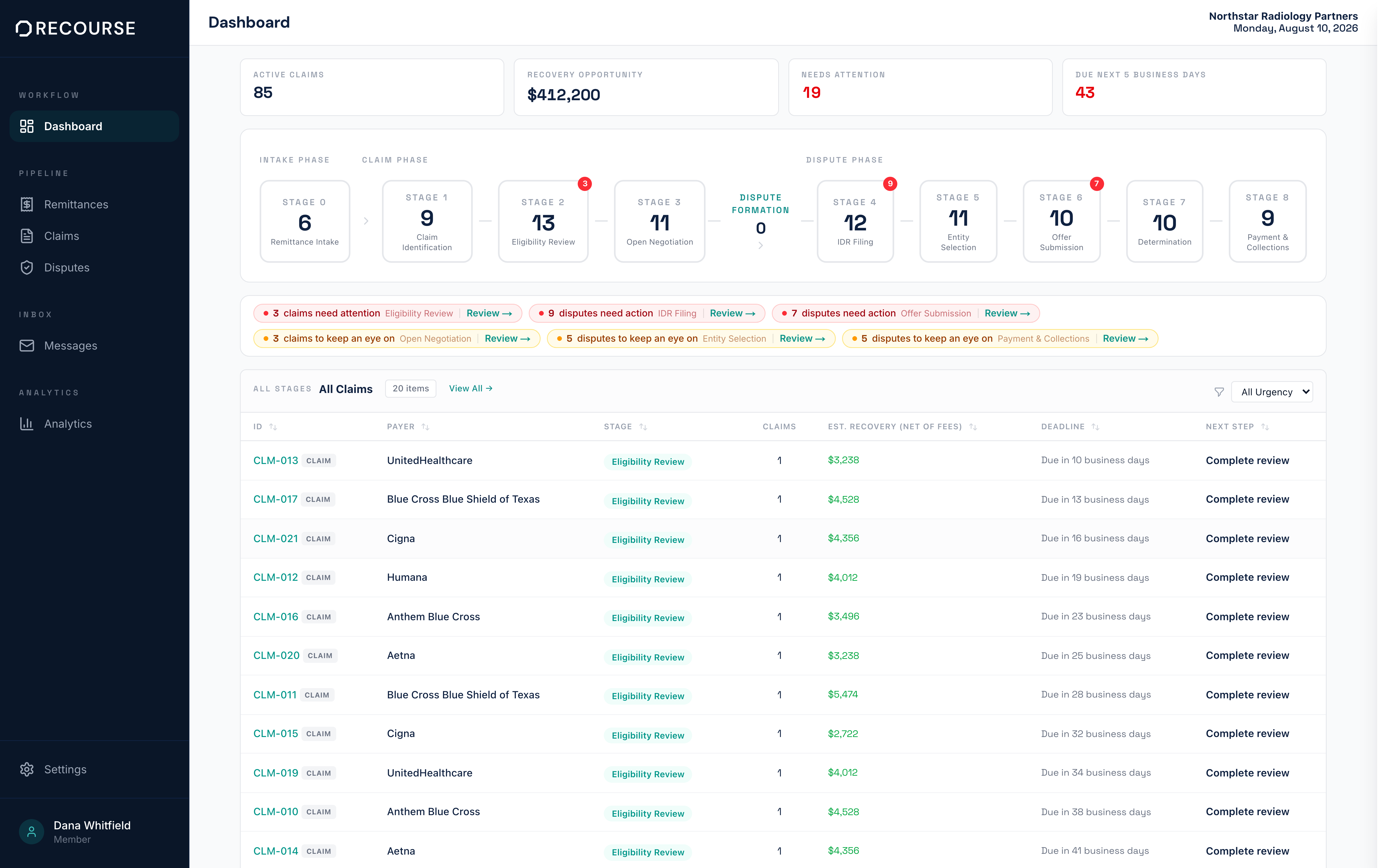
Your team keeps working in the systems it already uses. Recourse starts with the standard 837 and 835 files you already produce and runs IDR alongside your current workflow. Remedy never decides a money line or a counter-offer on its own: those come to your team with the reason written down, and it only acts alone after 50 clean confirmations.
Your IDR report card
Your one-page report card shows six grades, your dollar gap, and what to fix first. Every grade is a percentile against filers who ask as much as you do.
Federal IDR report card
Six peer-graded measures
649 filers graded
Coverage
Are you finding every eligible claim?
Ask
Do you ask for enough?
Execution
Do you finish what you start?
Cost
What does recovery cost?
Conversion
Do strong asks turn into awards?
Consistency
Is it a system, or is it luck?
Your peer position · Your recovery gap · Your first action
We’ll send your one-page report card with your grades, peer position, and recovery gap.